
The lawyer payment plan is a financing program that allows customers to pay their legal fees gradually rather than all at once. These contracts state clearly when payments are due. They further clarify the payment amount and what happens if there are no payments.
key takeaways
- Lawyer payment plans are arrangements where customers pay their legal fees gradually and not all at once.
- Billing arrangements can boost collection rates and cash flows for law firms.
- Attorney payment plans increase accessibility to legal services by a wide customer base.
- Billing systems automate payments, making them less of a hassle.
- Financing from third parties provides law firms with immediate payments.
- Payments are outlined clearly so that there is no room for disputes.
Some law firms stick to a standardized structure that could be half paid upfront and the rest afterward. Others choose to come up with personalized programs based on their clients’ financial situation and legal requirements.
A well-implemented payment plan can aid the law firm in scaling up and developing better client-lawyer relations. And that is much needed for a healthy bond between a laywer and client.
Make Billings Easier Now!
Help more customers pay for your services while maximizing your law firm’s cash flow with intelligent lawyer payment plans. The smart billing system can streamline billing and build better trust.
Payment Plans vs. Legal Fee Financing: Which One is Best for You?
Both payment plans and legal fee financing assist in facilitating clients in making legal payments in a manageable way. However, they are entirely different in nature.
Under the traditional payment plan, the law firm handles all aspects related to the program. Clients make partial payments to the law firm in agreed intervals until the balance has been cleared.
On the other hand, legal fee financing entails the intervention of a financing party who pays the law firm first and then makes the client make repayments on behalf of the law firm.
It is essential to note that understanding the advantages and disadvantages of these models will assist firms in choosing the most appropriate one.
Payment Plan
- Clients pay law firms gradually
- Law firms receive payments gradually
- In-house process; no financing company involved
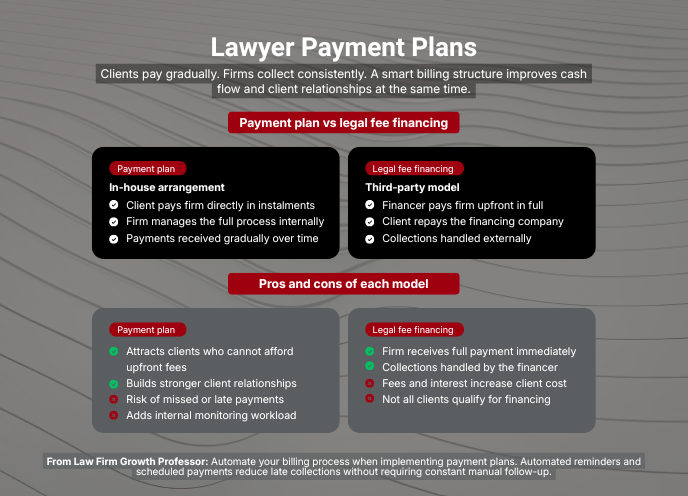
Legal Fee Financing
- Client repays financing companies
- Law firms receive full payment immediately
- Third parties finance and handle collections
expert tip
“The best way to implement a payment plan is to use the automation of billing processes at your law firm.”

David Reynolds
Law Firm Operations Consultant
Advantages and Disadvantages of Payment Programs
Payment programs by attorneys could be beneficial for both law firms and their clients because they ensure lower prices on legal services and help firms sustain income from their operations.
Main Pros
More clients: Attorneys would have an opportunity to attract additional clients since many people cannot afford hefty upfront fees.
Cash flow optimization: Payments on a regular basis ensure consistent income, thus enabling firms to forecast their expenses and revenues.
Better client relations: The ability to pay legal services in installments proves that law firms understand their clients’ needs and problems.
Collection risks decrease: Clients find it easier to pay smaller sums than large upfront fees, which minimizes the probability of late payments.
Possible Cons
Risk of defaults: Clients might fail to pay for legal services or be unable to cover all installments of the debt.
Increased workload: Law firms might need to monitor and follow up on payments to ensure their timely delivery.
Financial risks: Overdependence on payments by clients may lead to financial problems if many clients default on payments at the same time.
Legal aspects: Lawyers need to consider various legal and moral requirements when designing payment programs.
Advantages and Disadvantages of Legal Fees Financing
Legal fees financing may ease financial stress among law firms, as well as provide clients with yet another source of funding for their legal work.
Main Pros
Guaranteed payments: The legal fees financing firm guarantees that the entire sum will be paid to the lawyer without any collection risks.
Increased client options: Financers usually have more flexible payment options than most law firms do.
Reduced workload: Invoicing and collection processes can be handled by the finance company.
Marketing benefits: Some finance companies help law firms market their legal services.
Possible Cons
Increased expenses: Fees and interest rates associated with the financing deal make the final amount higher.
Limited eligibility: There will be some clients who are unable to access such financing because of financial restrictions.
Regulatory issues: Lawyers must ensure that the financing company complies with all relevant laws.
Grow Your Law Firm Faster!
Clients are now looking for payment flexibility when working with legal services. You need to adapt yourself and streamline the process with the proper approach that Law Firm Growth Professor comes up with.
Conclusion
Lawyer payment plans are now super relevant to any modern billing procedure. These plans are exactly what help the law firms optimize their finances, minimize payment difficulties, and build a friendly relationship with the customers. Law Firm Growth Professor can help you develop such a plan and follow it to the point of success.
FAQ
What are lawyer payment plans?
Lawyer payment plans are billing arrangements that allow clients to pay legal fees in smaller installments. They do not have to pay the entire amount upfront.
How do payment plans work in law firms?
A payment plan for lawyers divides legal fees into scheduled installments. Weekly or monthly. Depends on the agreed terms between the client and the law firm.
Can lawyers legally offer payment plans?
Lawyers can offer payment plans as long as the agreements comply with ethical and legal regulations.
Why do law firms offer payment plans to clients?
Law firms offer attorney payment plans to improve accessibility, attract more clients, increase collection rates, and create more predictable cash flow.
What types of payment plans do lawyers use?
Lawyers may use various payment plans. Installment agreements. Retainer-based billing. Subscription-style payments. Third-party legal financing. Really varies from lawyer to lawyer.