
The IOLTA account meaning is a type of trust account whereby a lawyer can keep unearned funds. The funds belong to random clients. The key issue regarding such funds is the fact that they should be kept separately from the personal or business funds belonging to the lawyer.
key takeaways
- The definition of an IOLTA account implies a trust account used to hold unearned or short-term client funds.
- Trust accounts of lawyers should always stay separate from the individual or business accounts.
- IOLTA accounts gather small client funds to earn interest to finance public legal services.
- No benefit whatsoever may be received by a lawyer from the interest of an IOLTA account.
- Transfers into the operating account occur after the earnings and after approval of clients.
- Failure to properly manage the IOLTA account leads to penalties such as suspension or disbarment.
The origins of the IOLTA program appeared in the ’80s. There emerged an idea that time to gather all the small or short client funds to create one interest account. Just imagine that.
No interest could be earned on the funds separately. They earn interest when combined. Interest payments are used by state bar associations to finance their programs.
Stay Compliant and Get Paid Faster!
Automate your trust accounting and payments with our law firm-specific solutions.
When Should an IOLTA Be Used? The Right Time in Your Hands!
When your firm gets unearned money like retainers or money held in trust for your client, it needs to be put in an IOLTA account. Payments for the services already performed do not require depositing in the IOLTA and, in this case, can go straight to your operating account.
Whether or not you need to use the IOLTA account depends on the regulations of the respective states, and, therefore, it is recommended to consult with the state’s bar association or an accounting expert on this matter. Nevertheless, since IOLTAs support important public causes, they are generally considered a best practice.
IOLTA vs. IOLA
The two terms serve the same function of keeping client’s funds while they have not yet been used, however, they are slightly different only due to nomenclature – IOLTA is used everywhere except New York (where they call it IOLA).
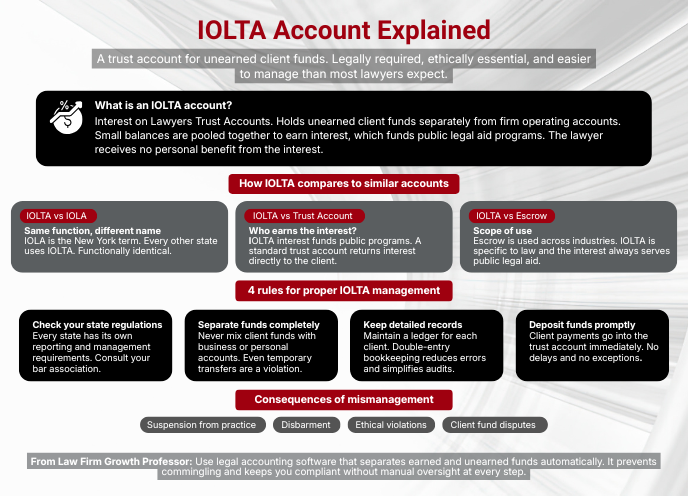
IOLTA vs. Attorney Trust Account
In addition to the common feature of storing client’s funds, IOLTA differs from attorney trust accounts by its use for pooling small amounts of clients’ funds with the generated interest being donated to public programs whereas interest on attorney’s trust account belongs to the client.
IOLTA vs. Escrow Account
An escrow account is more widely used in different industries since it holds money pending the fulfillment of some requirements. The main distinction between both terms is that, while IOLTA interest serves the purpose of funding public initiatives, the interest generated by an escrow account depends on the parties’ agreement.
expert tip
“Use specialized legal accounting software that can distinguish between earnings. You will be able to prevent any possible commingling and stay compliant with IOLTA regulations.”

David Reynolds
Law Firm Operations Consultant
Proper Management of IOLTA with Best Possible Practices
Managing an IOLTA account properly takes time and effort. It is critical to avoid various problems. Some practices should be considered in this context:
1. Check the Regulations in Your State
Every state has its own regulations regarding trust account management, reporting, and how to put money into an IOLTA. However, regardless of the jurisdiction, clients’ funds must always be separated.
2. Separate Funds Completely
Commingling means mixing the funds from the client’s account with those from business or personal purposes. Even a temporary transfer from a trust account to a bank account is highly risky.
3. Keep Proper Documentation
Every transaction must be carefully recorded in a ledger for each client. Double-entry bookkeeping will help to make the process easier and minimize mistakes.
4. Make Deposits Promptly
Client payments, particularly checks, need to be deposited in the trust account immediately. This practice is essential to maintain proper balance and ensure compliance.
IOLTA accounts are very important in law practices. The accounts provide protection of client money, uphold the ethics code of conduct, and support legal aid programs. Although they are quite complicated, with proper knowledge, management becomes easy.
Revolutionize Your Law Firm Accounting!
Billing automation and trust account tracking and effortless compliance. All within reach at Law Firm Growth Professor!
Conclusion
Knowing an IOLTA account meaning is essential not only for compliance but also for being an ethical and competent attorney. Properly managing your lawyer trust account will help you keep your clients’ money safe, avoid legal complications, and maintain the reputation of your law firm. IOLTA is entirely manageable once you have the right resources in place, despite seeming complicated at first.
FAQ
What does IOLTA mean in law?
IOLTA means Interest on Lawyer Trust Account. One of the most important bank accounts in legal practice. That is where lawyers store client funds they do not earn and where interest goes to support public law aid projects.
Why does a lawyer need an IOLTA account?
Lawyers need an IOLTA account to safely store their funds. This is how they remain compliant with ethical standards issued by local bar associations.
How does an IOLTA account work?
Client funds are deposited into the account. Legal services are completed. Earned fees are transferred to the operating account while the remaining balance stays in trust.
Who is required to have an IOLTA account?
Most attorneys who handle client funds are required by their jurisdiction to maintain an IOLTA or similar trust account.
What is the difference between an IOLTA account and a regular business account?
An IOLTA account holds client funds and cannot be used for business expenses. A regular business account is used for a firm’s operational income and costs.