
Law firm invoicing goes beyond just sending bills to clients. Client trust and money flow depend on it. In addition, it determines how professional a law firm can be in a competitive environment. Many attorneys earn less due to inefficient or old billing.
key takeaways
- Invoices should be detailed to prevent disputes.
- Bill should be followed up on ASAP after completion of the job.
- Current invoicing software is efficient.
- Various clients have various invoice preferences.
- Legal billing policies aid team coordination.
- Smooth billing fosters good client relations.
The thing is that today’s clients expect transparency. They need invoices that are clear and payment methods that work well for them. Clients also need to be sure that all charged hours add value.
No surprise that nowadays law firms focus on improving the billing procedure. Efficient attorney billing leads to prompt payments and makes it possible to expand a business without causing extra stress for legal experts. Smart law firm invoicing practices make the difference between ordinary and profitable businesses.
Transform Your Firm with Billing Systems!
Law Firm Growth Professor helps legal professionals create innovative and efficient client experiences. Develop an invoicing solution that will help you generate client satisfaction and boost the efficiency of the process.
Understanding the Fundamental Kinds of Law Firm Billing Models
Legal services vary. Hence, choosing the right billing structure for each one improves client satisfaction and profitability.
Hourly Billing
This is the most conventional form of billing. Lawyers measure their working hours and charge clients accordingly.
An hourly billing model for attorneys serves litigation or unpredictable cases well. It provides flexibility on the one hand. It leaves clients uncertain about costs on the other hand.
Flat Fee Billing
The client pays a single flat fee for a service. This billing system suits contract preparation, writing wills, filing trademarks, or any other standard legal process.
Flat fees ensure more transparency as clients know how much they will have to pay in advance.
Contingency Billing
The lawyer does not receive payment until they win the case. In such cases, compensation is a proportion of the awarded sum.
This billing system prevails in personal injury law.
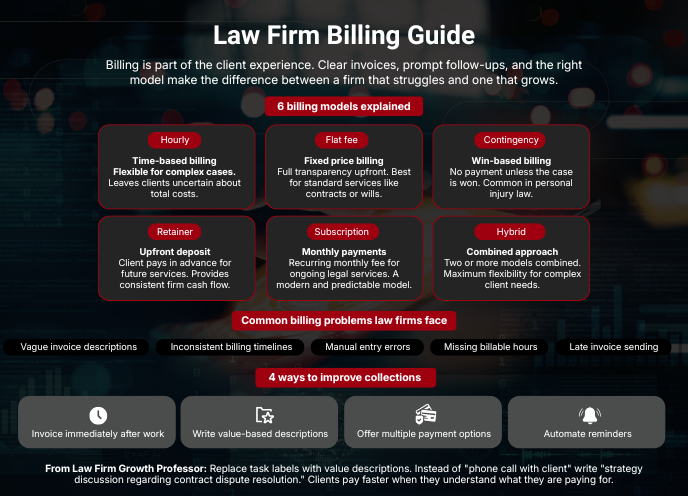
Retainer Billing
Clients provide an upfront deposit that will pay for future services from the law firm. The retainer covers expenses that occur in the process.
Retainer billing allows firms to have a consistent cash flow.
Subscription Billing
Some modern law firms have shifted towards a subscription-based model. It involves monthly payments for their legal services.
Hybrid Billing
Hybrid pricing utilizes two or more billing methods. As an illustration, law firms could use a combination of flat fee and success-based billing.
This allows lawyers to be flexible when setting fees.
The Greatest Problems With Law Firm Billing Practices
Most law firms face late payments and poor timekeeping practices. This is because most firms still use outdated systems.
- Vague invoices are one of the major problems many law firms face. Clients prefer clear invoices, and having generic charges such as “work done” in an invoice confuses them.
- Inconsistent billing processes cause problems in many law firms. Late invoices are often associated with late payments.
- Manual billing causes many errors. The chances of missing billable hours and making mistakes during the billing process are high.
- Law firm billing best practices would solve all of the above problems.
expert tip
“Create invoice descriptions that explain value instead of just tasks. Do not write “phone call with client”, write “strategy discussion regarding contract dispute resolution.” This sounds more professional and helps clients understand the importance of the work completed.”

David Reynolds
Senior Legal Billing Consultant
Improving Collections Without Compromising Client Relations
- Lawyers tend not to mention fees since they worry about affecting their relationship. However, clients actually prefer transparency.
- Issue invoices on time. Write clearly. Provide various payment options.
- Automated notifications can help minimize uncomfortable discussions. Clients sometimes forget about making payments. They do not intend to cause any delays.
- Payment plans have been implemented by some law firms in large cases. It makes payments more convenient and enhances collections.
- Transparency is still the key principle. Clients seldom object to reasonable charges if they know what they will gett in return.
Make Billing Easier With Law Firm Growth Professor!
We assist law firms in upgrading their technology systems to enhance operational efficiency. From client relations to billing, we enable firms to maintain competitiveness in the market.
Conclusion
Law firm billing is not just about accounting anymore. Law firm billing is a part of the experience of being a client. Good law firm billing makes your clients more trusting. Law firm billing makes your business more profitable. And law firm billing leads to stability. Law firms that focus on new methods of law billing are positioned to take advantage of rapid changes in the legal field. Any firm can succeed with the proper systems and law firm billing guidelines.
FAQ
What is law firm billing and how does it work?
Law firm billing is the process lawyers use to charge clients for legal services. Firms track work completed and generate invoices based on agreed pricing methods.
What are the different types of legal billing methods?
Hourly billing. Flat fees. Retainers. Contingency fees. Subscription pricing and hybrid billing models. This is the stuff common billing methods include.
What is the best billing method for law firms?
The best billing method depends on the practice area and client needs. Many firms use a combination of billing models for flexibility.
How can law firms improve their billing process?
Automation. Creation of clear invoices. Tracking time well. Online payment. Law firms can use all of that to improve billing.
Why are law firm billing guidelines important?
Consistency creation. Transparency improvement. Reduced payment disputes. These are more than enough reasons of why law firm billing guidelines are important.