
Law offices manage money belonging to clients on an everyday basis. Every single dollar comes with duties. One wrong transaction could lead to an ethics violation that would tarnish a lawyer’s reputation for many years. This is why it is important to understand the commingling of funds problem.
key takeaways
- The commingling of funds takes place when lawyers combine the money belonging to clients with their own personal or business finances.
- Even an innocent mistake made in trust accounts will prompt ethics probes and stringent discipline proceedings.
- Trust fund accounting maintains client confidence and enhances the reputation of the law practice.
- Having distinct bank accounts and keeping proper books of account are vital in preventing commingling.
- Use of legal accounting software and regular reconciliation are helpful in minimizing accounting errors.
- Lawyers who observe proper financial controls build better businesses and ensure sound growth prospects.
A lot of lawyers wonder what commingling is. Why is commingling funds crucial even if payments are ultimately made correctly? The explanation is straightforward. Client money must always remain safe. Any mixing of funds, no matter how temporary, is considered malpractice. Some lawyers think slight accounting issues are not a big deal. Bar associations disagree with such views.
There are high expectations from the legal community regarding trust accounting. Lawyers cannot afford to make any errors in their trust accounting system. It is crucial to avoid confusion and provide transparency. Important to minimize the chances of fraud.
Have Your Law Firm Achieve Growth!
Get it done while maintaining compliance. Our law firm growth professor will work with you to establish a system that will protect your profit and reputation.
Why is the Commingling of Funds a Serious Legal Issue?
Commingling of funds takes place when a lawyer commingles client funds with personal funds or operational funds. This takes place within the confines of a trust account or an operating account. The client’s funds in legal practice are the property of the client and not the lawyer.
Lawyers have many times asked whether the commingling of funds is illegal or unethical behaviour. This behaviour leads to disciplinary action and also legal liability in most cases. Bar associations normally treat this as professional misconduct. Serious cases will end up in suspension or disbarment.
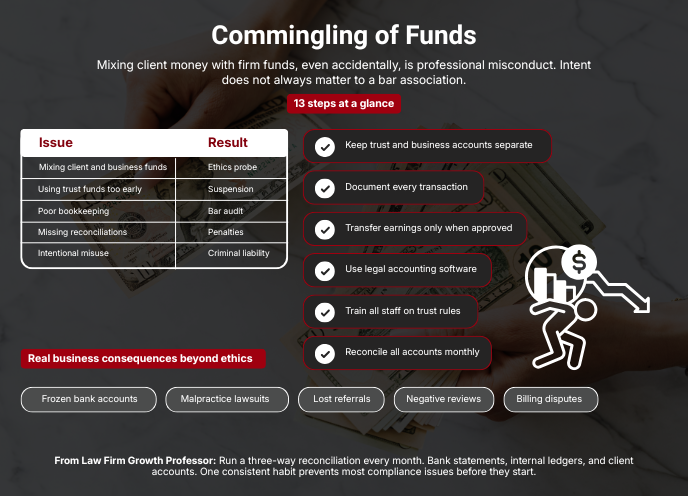
Below is a quick summary of what lawyers should know when they fail to follow proper trust accounting procedures:
Issue | Potential Result |
Mixing client and business money | Ethics investigation |
Using trust funds too early | License suspension |
Poor bookkeeping records | Bar audit |
Missing reconciliation reports | Financial penalties |
Intentional misuse of funds | Civil or criminal liability |
Lawyers must understand that intent does not always matter. Even accidental trust account violations can lead to discipline.
Why Is Commingling Funds So Important?
Confidence forms the very core of any professional relationship in the legal practice. When clients hire attorneys, they trust them with their personal information and payments. Should lawyers make mistakes regarding the money, clients will not trust the whole profession anymore.
There are multiple ways this may affect your business, other than ethical violations:
- Your bank account might be frozen.
- Clients may sue you for malpractice.
- Your referral sources may stop giving you clients.
- Bad online reviews may prevent any future growth.
The problem may lie inside the office itself. It will be hard for your staff members to check how much money there is. Billing disputes will become a regular thing. The process of tax filing may become difficult.
expert tip
“Establish a tri-party reconciliation procedure on a monthly basis. Analyze bank statements. Analyze internal ledgers. Analyze client accounts. Just one step can prevent mistakes early on and significantly reduce the risk of compliance issues.”

David Reynolds
Senior Legal Billing Consultant
Six Essential Points Every Attorney Should Understand
1. Trust Account is Not A Business Account
It is never wise to use trust account funds to pay for operating expenses, such as rent, payroll, marketing, and subscriptions.
2. Documentation Safeguards All Interests
There must be documentation of each transaction. Firms must monitor their deposit and withdrawal activity, client balances, and reconciliations.
3. Little Things Turn Into Big Mistakes
Many ethics inquiries start with simple errors in recordkeeping. Bad habits result in avoidable mistakes.
4. Earnings Must Be Properly Transferred
Funds collected under retainers should be maintained separately until the earnings are transferred to the operating account.
5. Technology Mitigates The Risk
Automated software solutions minimize human error in accounting, reporting, and reconciliation.
6. Proper Staff Education Pays Off
Lawyers will not escape responsibility regardless of who handles the firm’s books. All employees involved with cash transactions must know the rules of trust accounting.
Law Firm Growth Professor Provides Resources!
Get them for responsible growth in law firms through strategic operational processes and financial management systems.
Conclusion
Commingling of funds should not be viewed as a mere bookkeeping issue but as a matter of professionalism. Firms that know the meaning and importance of commingling of funds will have an easier time succeeding. Good trust accounting ensures safety for both attorneys and clients. Professional handling of finances also improves a law firm’s credibility among competitors.
FAQ
What does the commingling of funds in a law firm entail?
Commingling of funds occurs when a lawyer blends client funds with his personal or business monies rather than maintaining separate bank accounts.
Why is the commingling of funds in legal practice unethical?
This practice contravenes professional standards since the funds of the client must be secure and traceable at all times.
When a lawyer commingles trust account funds, what does it signify?
This means that monies of the clients have been deposited alongside the attorney’s personal funds or income.
Does commingling of funds constitute an offence?
The answer varies by jurisdiction and severity. Some cases lead to ethics penalties. Intentional misuse can also trigger civil or criminal consequences.
How can lawyers prevent commingling of funds?
Lawyers can prevent problems by maintaining separate accounts. Using legal accounting software. Performing monthly reconciliations. Training staff properly. Following written trust accounting procedures.