
Compliance with PCI is not always understood in terms of its legal aspects. Whenever you receive credit card payments, you have probably been told about the PCI rules. However, the big question here is whether or not your business must comply with them, legally speaking. There are no clear yes or no answers here.
PCI compliance is not enforced by government law. It is mandated by credit card companies through contractual agreements. This means that failing to follow PCI compliance laws can result in serious consequences, even if PCI law may not sit in a legal statute.
PCI compliance is a necessary measure of operational necessity. If you want to continue accepting card payments securely and maintain customer trust, following these standards is non-negotiable.
What Is PCI Compliance? Do PCI Compliance Laws Apply to Law Firms?
Being PCI compliant merely means adhering to the guidelines of the Payment Card Industry Data Security Standard (PCI DSS). That was established in 2006 by the Payment Card Industry Security Standards Council: an organization founded by the world’s foremost credit card organizations.
If you have credit card transactions at your law firm, then PCI compliance is applicable, without exception. The exact requirements depend on the number of transactions processed in a year.
- Providers classified as Level 1 (more than 300,000 transactions+ per annum) are obligated to conduct annual assessments via a Qualified Security Assessor (QSA).
- Providers categorized as Level 2 (1 to 300,000 transactions per annum) may perform their own assessment via the Self-Assessment Questionnaire (SAQ-D).
It is often asked if PCI compliance is mandatory by law. Not a legal requirement, but it is enforceable by credit card firms. Do not take it lightly, as it will mean severe fines and legal ramifications if ignored.
Why PCI Compliance Matters for Law Firms? Let Us Explain
1. Stop the Scam before it Happens
Fraud with credit cards is a widespread problem around the world that costs billions each year. The PCI standards help mitigate these risks by making sure that your system isn’t vulnerable to cybercrimes.
2. Preserving Client Confidence
Being a lawyer means working with sensitive information. But what happens when that sensitive information has money attached to it? Data breaches not only compromise security; they destroy reputation. And not only do you lose money from the breach itself. You must now notify all of your clients.
3. Safeguarding from Heavy Fines
For smaller firms, this could mean paying thousands each month in fines for non-compliance. But that’s just the beginning; when a data breach actually occurs, legal fees, settlements, and loss of clients can cause significant problems.
Core PCI Compliance Requirements Simplified For You
1. Safeguard Your Network
Deploy firewalls, remove old software, and establish strong passwords. Hackers love exploiting weak points of entry.
2. Protect Cardholder Information
Protect all stored data and secure every communication. Even when hackers get through, they will not be able to understand anything.
3. Address Security Vulnerabilities
Always use updated malware protection software. Update systems regularly. Cyber-attacks change rapidly. You should adapt as well.
4. Limit Access
Restrict access to only necessary employees. Every user should have a unique login and multi-factor authentication to control access.
5. Regular Monitoring and Testing
Monitor everything happening on the network and analyze logs. Conduct regular testing for cybersecurity weaknesses.
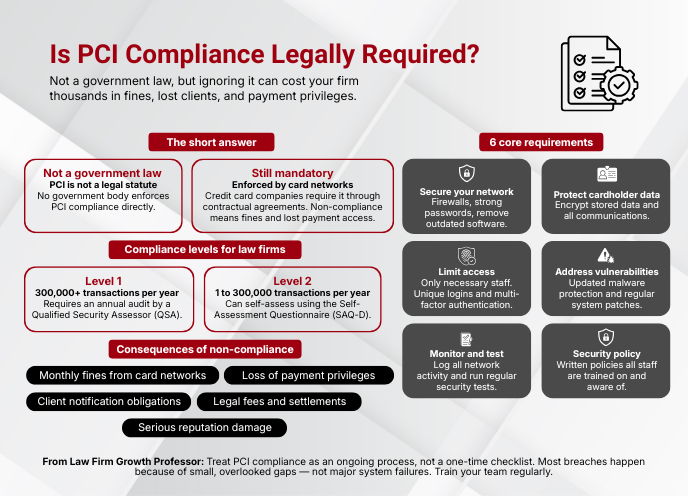
6. Have a Policy on Security
Establish your policies regarding information security and make sure that all of your employees are aware of them.
How Do You Guarantee Your Business Is Compliant? How Payment Software Could Simplify PCI Compliance?
Approach PCI compliance in the same manner you approach a checklist. Evaluate all requirements. Figure out what needs to be done and document any missing items. All aspects, starting from setting up a proper firewall to access control mechanisms and periodic testing, help improve security measures.
PCI compliance may seem like an extensive challenge to perform internally. However, a third-party PCI-compliant processor could take over some functions and thus reduce your compliance effort.
Conclusion
PCI compliance is an absolute must when it comes to running a law firm that handles payment cards. The consequences for failing to comply could be catastrophic. Hefty fines and damage to reputation and and loss of trust from clients. Just know that you can ensure compliance without impacting your business.